6.4. Combined plates
🔹 4. Combined plates (mixed DCP / locked)
🧩 Description and components
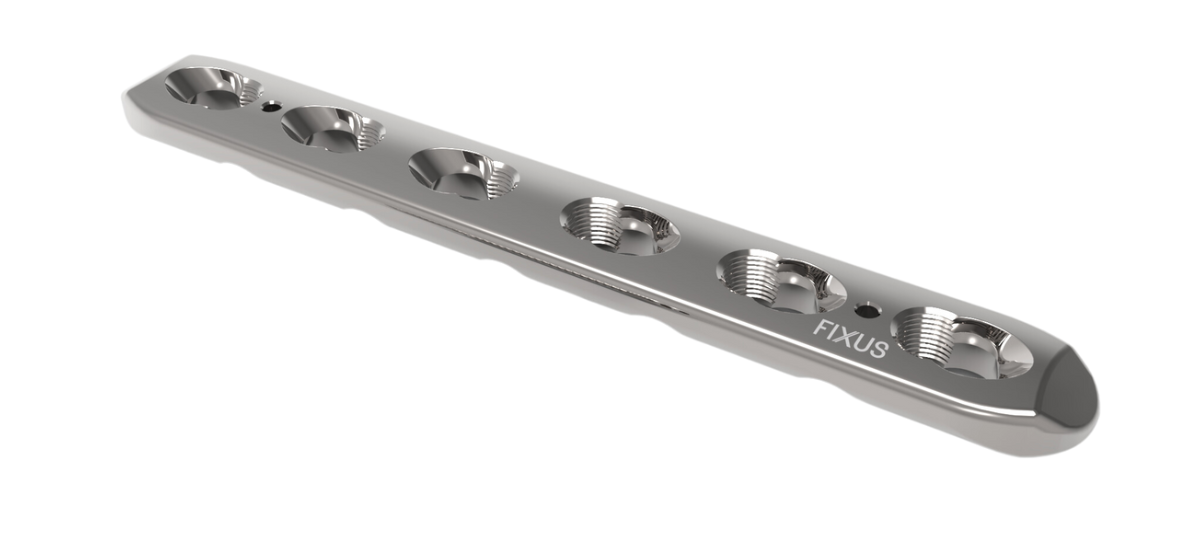
Combined plates are designed to offer two mechanical functions in a single implant.
They retain the general shape of a DCP or locked plate, but each hole is divided into two distinct zones:
- One smooth oblong part allowing the use of a cortical screw to create dynamic compression (DCP principle).
- One threaded part allowing the use of a locking screw to create a rigid screw–plate connection (locked principle).
Illustration :
⚙️ Mechanical principle
The surgeon chooses, hole by hole, the desired effect: compression or locked angular stability.
- Compression: by using a cortical screw positioned in the oblong part of the hole.
- Locking: by using a locking screw positioned in the threaded part.
The two mechanisms can be combined on the same plate and in the same surgery: initial compression of one fragment, then locking of the others for overall stabilization.
This system allows mechanical customization of the fixation, depending on:
- type of fracture (simple, oblique, comminuted…),
- bone quality (healthy or osteoporotic),
- overall budget (mainly depends on the number of locking screws used),
- or the surgeon’s preference.
✅ Advantages
- Maximum versatility: a single plate allows adapting fixation to different zones of the fracture.
- Compression possible on one segment, locking on another.
- Stock optimization: less need to multiply dedicated models.
- Allows a progressive approach: some surgeons start with compression, then lock to secure fixation.
⚠️ Limits
- Cost significantly higher than a DCP plate alone.
- Requires a good understanding of both principles to correctly choose where to place each screw type.
- Risk of error if screws and holes are not properly matched.
💬 Takeaway
Combined plates allow, within the same plate, either the dynamic compression principle (DCP) or the locked screw–plate principle.
They therefore offer great flexibility and adapt to almost all types of fractures and bone qualities (versatility).
This system is particularly appreciated in versatile practices and by surgeons wishing to have a single implant for several fixation strategies.
Commenting is not enabled on this course.