1. Basics of Veterinary Orthopedics
Structure of bone
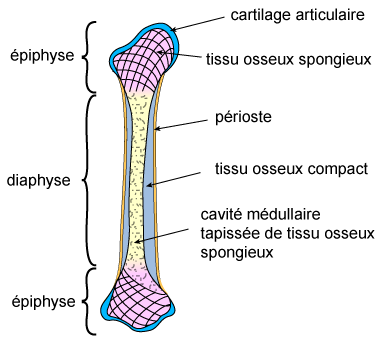
Bone is not a homogeneous, rigid material. It is composed of several zones, each playing an important role in strength and healing:
- Cortical bone (also called compact bone or compact osseous tissue): hard outer layer that provides strength.
- Spongy bone: more porous, vascular inner part that nourishes the bone and contributes to healing.
- Diaphysis: the central, long part of the bone.
- Epiphysis: the end of the bone, near the joints.
- Periosteum: a thin membrane that covers the bone, highly vascularized, essential for healing.
Illustration :
How a bone repairs itself
A bone is a living and dynamic tissue, capable of regenerating throughout life.
To heal, a bone needs stability and good blood circulation.
If it moves too much, consolidation does not occur properly.
Healing takes place in three main stages:
- Inflammation and cleanup: a hematoma (blood clot) forms around the damaged area
- Callus formation: cells (like a natural glue) produce a fibrous callus, which mineralizes to form a soft then hard callus
- Bone remodeling: over time and with mechanical activity, the callus adapts and the bone regains its shape and strength
The role of orthopedic equipment is therefore to stabilize the bone throughout this repair process.
The role of orthopedic equipment
Plates, screws, pins, or fixators temporarily replace the mechanical function of the cortical bone. While the callus forms and strengthens inside, they:
- Align bone fragments,
- Prevent parasitic movements,
- Allow bone consolidation,
- And can be removed or left in place as appropriate.
Commenting is not enabled on this course.