6.3. Locked plates
🔹 3. “Simple” locked plates (Locking plate)
🧩 Description and components
Locked plates take the concept of a simple plate screwed to the bone but completely change how stability is achieved.
Unlike simple or DCP plates, where stability depended on plate–bone friction, the locked plate relies on a rigid mechanical connection between each screw and the plate.
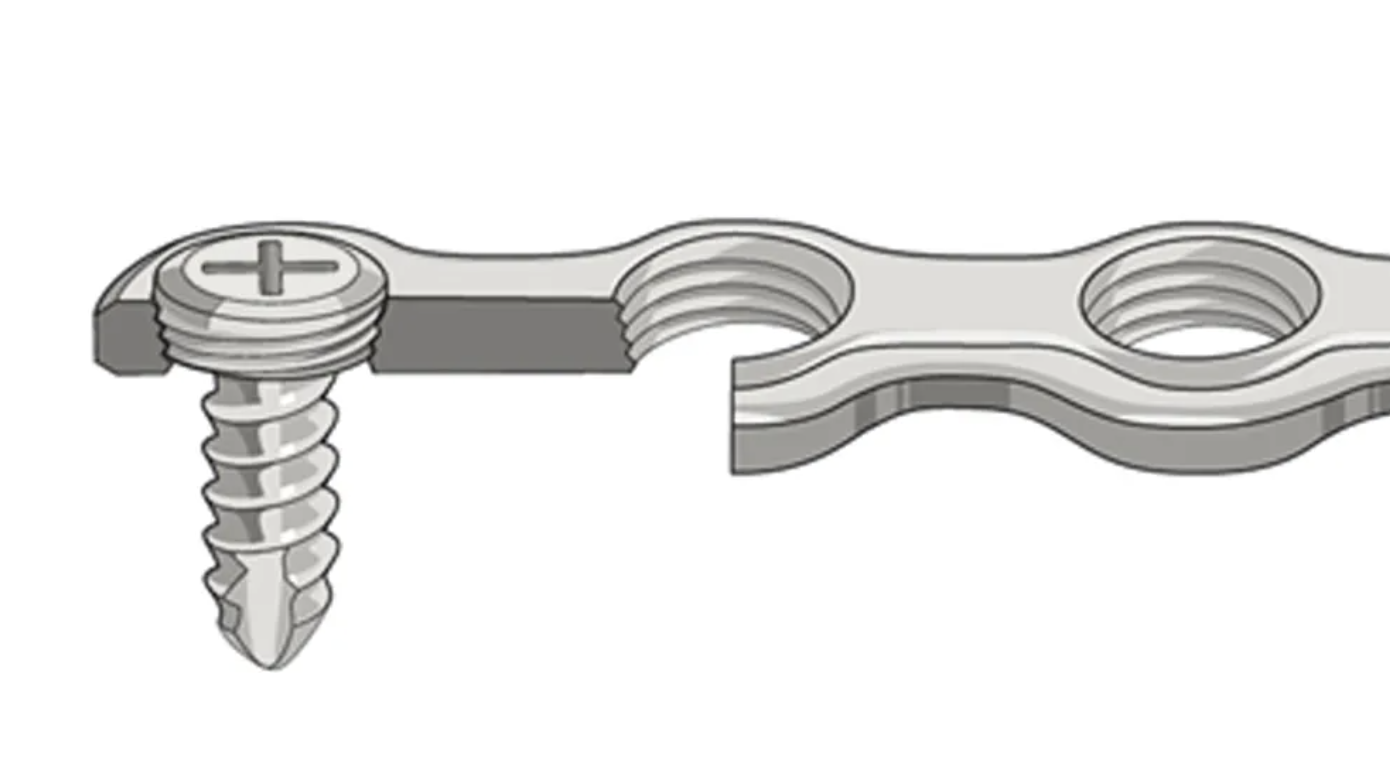
Specifically, a “simple” locked plate looks like a classic plate with round holes, but each hole is threaded inside to allow direct locking of the screw head.
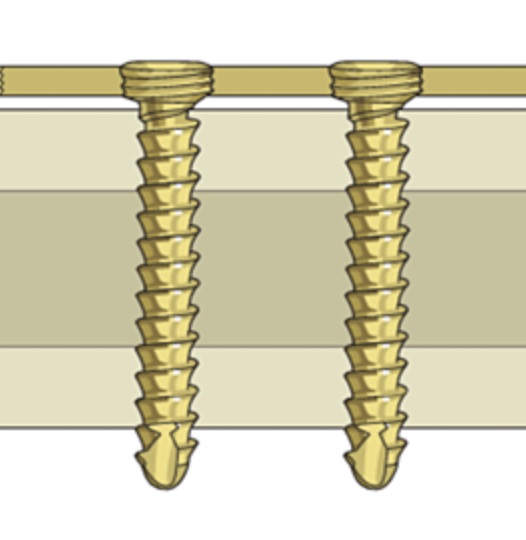
This threading creates a rigid mechanical connection between the screw and the plate, turning the assembly into a single self‑supporting structure.
Because of this monobloc structure, the plate no longer needs to be perfectly pressed against the bone.
Illustration:
 .
. 
🔩 Locked screws
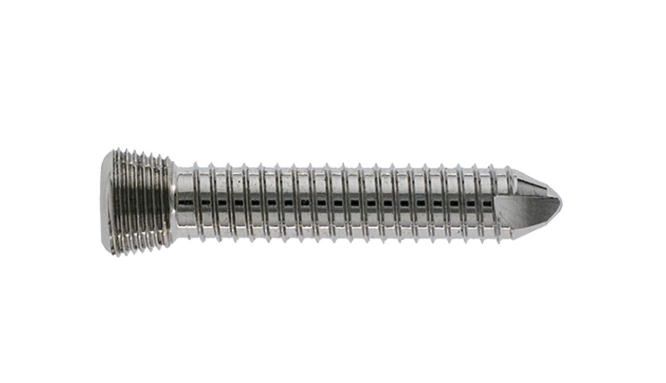
Locked screws are specific: their head is threaded, and this head screws directly into the plate into a corresponding thread.
Thus, each screw becomes mechanically integral with the plate, forming an extremely stable monobloc system. This is called the locked plate–screw system.
Locked screws are generally self‑tapping: they create their own thread in the plate hole and in the bone, which simplifies placement.
Illustration :
✅ Advantages
- Excellent stability, even in weakened, cancellous, or comminuted bone, or in cases of bone infection.
- No need for strong plate–bone contact, thus preserving the periosteum and improving vascularization.
- Less loss of reduction during healing.
- Rigid but “biological” construct: the plate acts as a bridging device, allowing the bone to heal under controlled strain.
- Easier placement: the surgeon does not need to contour the plate perfectly.
⚠️ Disadvantages
- Generally higher cost
- Little (or no) bone‑to‑bone compression → sometimes necessary to add an independent compression screw if interfragmentary compression is desired.
- Precise angular drilling required: the drilling axis of the locked hole must be respected using the drilling guide, otherwise the screw head will not lock into the plate.
💬 Takeaway
Locked plates (LCP) no longer rely on plate–bone friction for stability.
They create a mechanical lock between screw and plate, forming a self‑supporting, rigid structure.
This system is particularly suitable for complex, comminuted fractures or fragile bone, where a classic plate (simple or DCP) would be insufficient.
Commenting is not enabled on this course.