2. Types of fractures
We focus here on fractures, which are the most frequent cases and often the most urgent to address:
💥 Why it matters
- Understanding the type of fracture helps explain why there are different plates and screws.
- Each fracture requires a different level of stability, hence a different choice of equipment.
🩻 Major families
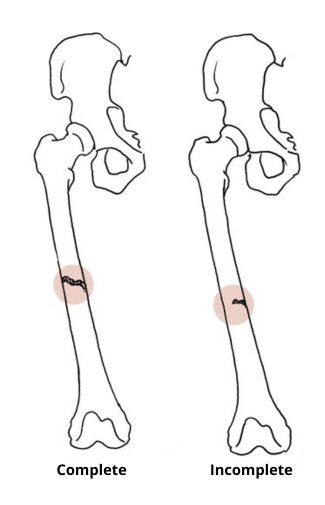
1. Complete fracture
The bone is broken across its entire width: the fragments are separated.
👉 Treatment: rigid fixation (plate + screws).
2. Incomplete fracture
The bone is cracked but not completely broken (like a greenstick).
👉 Often in young animals, lighter treatment. Exercise restriction. No bandage or with an external immobilization bandage, a cast resin, or a splint.
Illustration :
🧱 Shapes of complete fractures
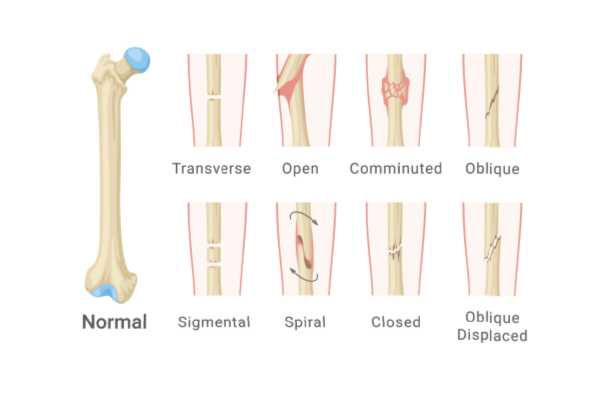
Type of fracture | Description | Clinical example | Difficulty |
Transverse | Straight break, perpendicular to the bone | Fall, direct impact | Simple to stabilize |
Short oblique | Slanted break over a short distance | Lateral impact | Moderate |
Long oblique | Extended slanted break | Severe trauma | Moderate |
Spiral | “Twisting” fracture around the bone | Limb torsion | Complex |
Comminuted | Bone shattered into multiple fragments | Severe accident | Very complex |
Segmental | Several separate breaks on the same bone | Polytrauma | Very complex |
All these types of fractures can be open (skin disrupted) or closed (skin intact).
Illustration :
⚙️ Impact on equipment choice
General principles:
- Young animal: high and fast healing capacity. The construct can be simple, lighter, less rigid.
- Older animal: low and slow bone healing capacity. The construct must hold for a long time and be very rigid.
- Simple fracture: fast healing. Light, low-rigidity construct.
- Complex fracture with bone loss: slow healing, very rigid construct.
- Open fracture: risk of infection that destroys bone and slows bone healing. Very rigid internal construct or external (external fixator).
- Mid-shaft fracture: there is room above and below to place sufficient hardware.
- Fracture of bone ends, near joints: there is very little room on one side. The joint must not be hindered by the implants. Use of pins or few screws with a stronger purchase (locking screws).
💡 Key takeaway: These situations can overlap and it is up to the surgeon to make the best choice adapted to the situation.
Commenting is not enabled on this course.