6. Orthopedic plates sustems
We now go into more detail on the internal fixation system with plates.
Before talking about shapes (straight, T, L, etc.), we need to understand how a plate acts mechanically on the bone. This is called the mechanical system of the plate.
Indeed, a bone plate is not just a simple piece of metal screwed onto a bone: it is a stabilization device designed to transmit and distribute the forces exerted on the skeleton during healing.
There are three main types of plates:
- Simple plates
- Dynamic compression plates (DCP)
- Locked plates
- Combined plates
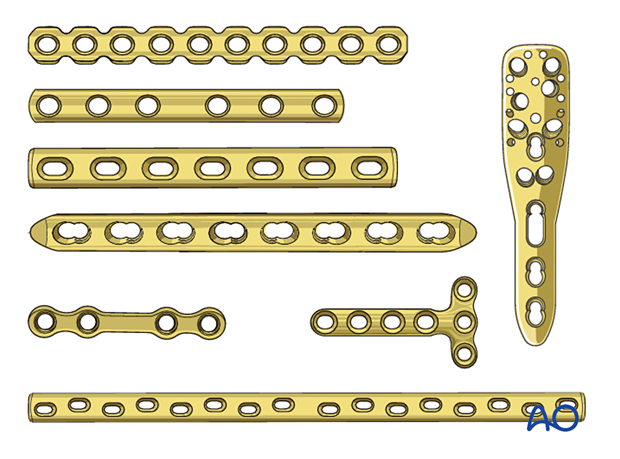
Each plate model generally exists in several physical variants, such as:
- Length: number of holes, thus the number of possible screws.
- Thickness: mechanical resistance (thicker → more rigid).
- Width: mechanical resistance and adaptation to the diameter of the bone.
- Hole diameter: determines the type and size of compatible screws.
As for screws, the main types are:
- Cortical screws (self-tapping or not)
- Cancellous bone screws
- Locked screws
They also come in several variants:
- Length: adapted to bone thickness.
- Diameter: depends on bone size and plate type.
- Drive or head: cruciform, hexagonal, stardrive, etc.
Each system corresponds to a different surgical philosophy, adapted to a type of fracture and a desired level of stability.
These different systems are developed in the following chapters.
Illustration :
Commenting is not enabled on this course.