6.2. Dynamic compression plates
🔹 1. Dynamic Compression Plates – DCP
🧩 Description and components
Dynamic compression plates (DCP) use the same basic principle as simple plates: they are fixed to the bone using cortical screws, and stability still depends on plate–bone friction.
The essential difference lies in the shape of the holes:
👉 each hole is oblong and angled.
Illustration :
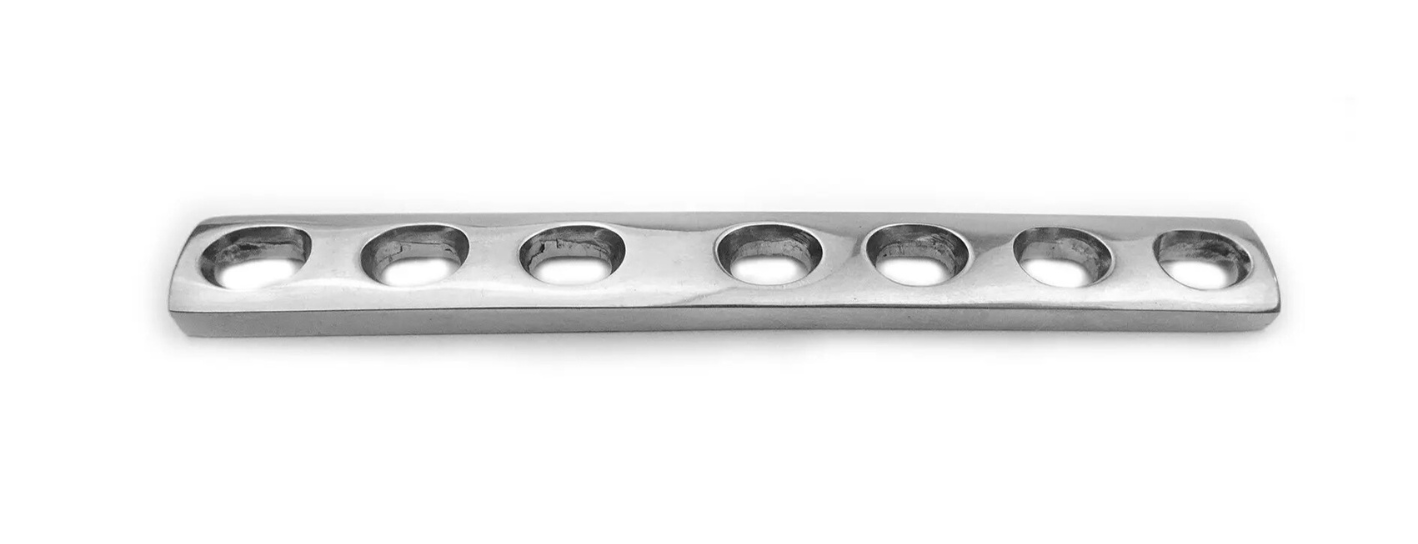
This geometry allows the screw head to slide laterally in the hole when tightening.
This sliding causes a controlled displacement of the bone fragment, thereby generating active compression of the fracture site.
In summary:
A simple plate stabilizes → a DCP plate stabilizes and compresses.
DCP plates are also used with cortical screws (self‑tapping or not) and cancellous screws, as seen previously.
🧱 Principle of dynamic compression
Each DCP hole has an internal ramp (or “slope”).
When the spherical screw head bears on this ramp during tightening:
- the screw slides laterally,
- and pushes the bone fragment it fixes toward the center of the fracture.
This movement causes a gradual approximation of the two bone fragments, i.e., dynamic compression.
This compression is called “dynamic” because it increases as the screw is tightened.
It is particularly useful in transverse or short oblique fractures, where firm, stable bone‑to‑bone contact is desired.
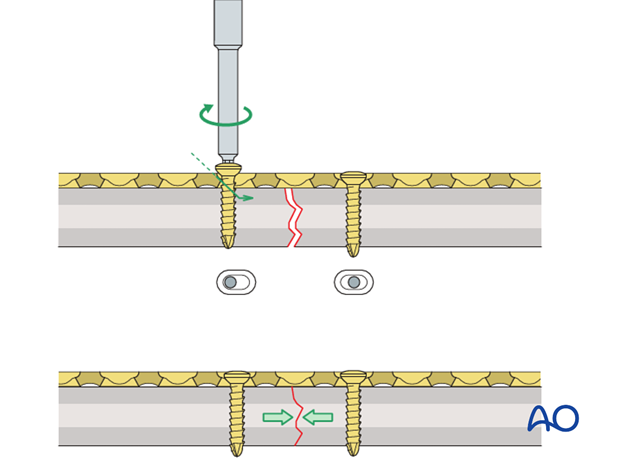
💡 To create compression:
- The surgeon begins by fixing one fragment (with screws centered in the holes).
- Then a screw is inserted in the inclined oblong area of the opposite fragment, placing it at the edge of the hole on the side away from the fracture.
- By tightening this screw, the fragment moves toward the center, bringing the two edges of the fracture together.
Illustration :
✅ Advantages
- Active compression of the fracture site.
- Simple, economical, versatile system: the screw can be placed in the middle of the hole (no compression effect) or offset (compression effect) as needed.
- Compatible with standard cortical screws and usual instruments.
- Very effective for simple, transverse or short oblique fractures.
- Versatile: used in veterinary medicine on many bone segments.
⚠️ Disadvantages
- As with simple plates, plate–bone contact must be perfect, otherwise there is a risk of loss of reduction during placement → need for precise contouring.
- Possible periosteal compression → risk of local slowdown of vascularization.
- Loss of compression possible if screws loosen (e.g., in cancellous or weakened bone).
- Less suitable for complex fractures or very deformed bones.
💬 Takeaway
A DCP plate works like an improved simple plate: it stabilizes the fracture by friction while adding active compression between bone fragments.
It still depends on good plate–bone contact and proper tightening quality, but provides a significant mechanical gain in simple fractures.
Commenting is not enabled on this course.