6.1. Simple plates
🔹 1. Simple plates
🧩 Description and components
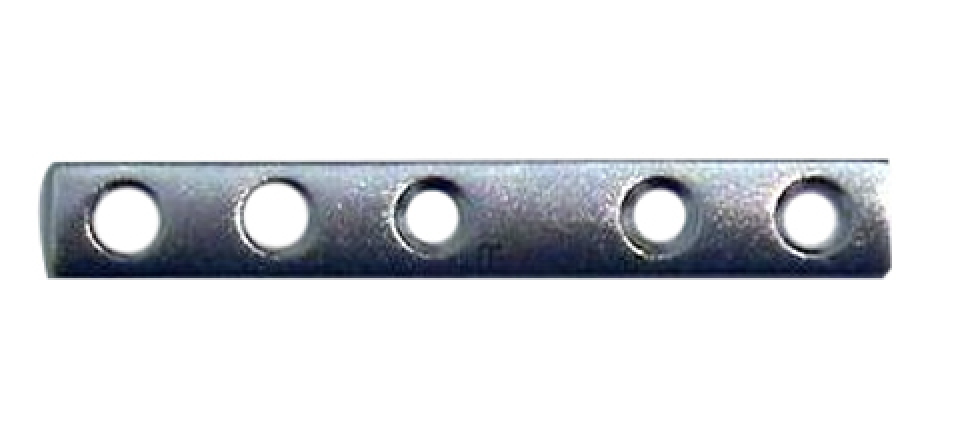
Simple plates are the most basic model of orthopedic plate.
They are generally flat, sometimes slightly curved, and have a succession of perfectly symmetrical round holes.
Simple plates are designed to hold bone fragments in position but without exerting compression at the fracture site.
Illustration :
🔩 Screws used: cortical bone screws (or "cortical screws"
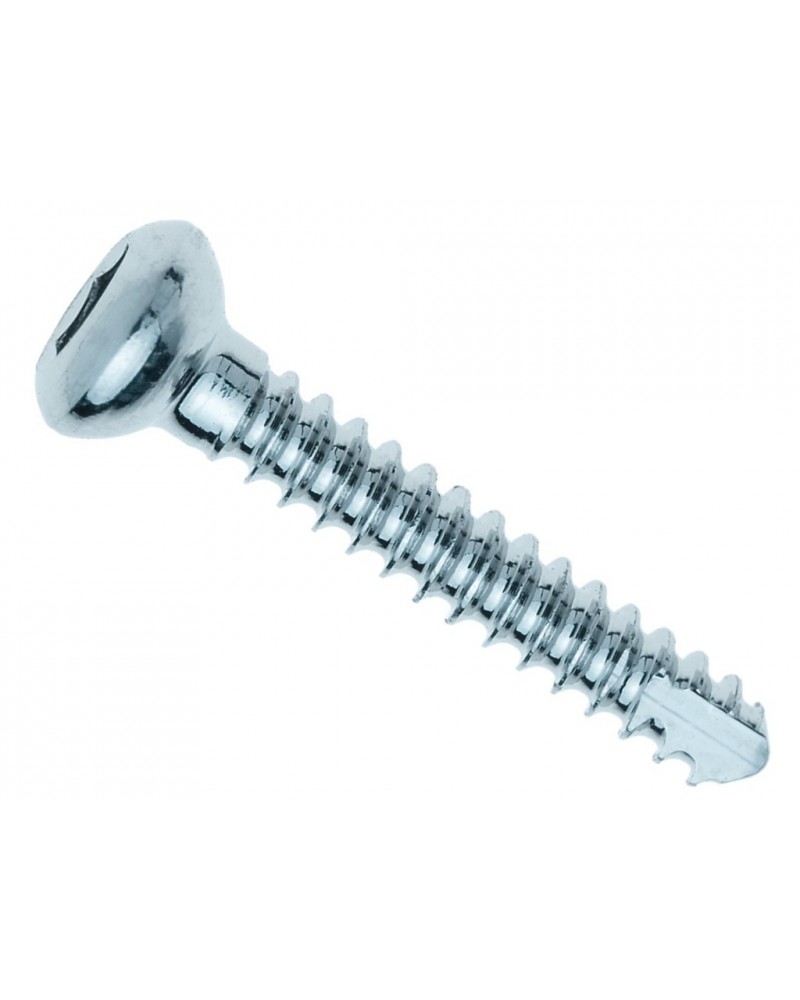
These plates are used with cortical screws (or cancellous screws).
- These screws have a spherical, smooth head.
- Cortical screws are threaded along their entire length because they are intended to pass through the cortical bone (the dense part of the bone).
- They can also be:
- self‑tapping → they cut their own thread in the bone during screwing (time‑saving, no prior tapping needed).
- non‑self‑tapping → Non‑self‑tapping cortical screws may require prior tapping of the bone, but this is not mandatory. The surgeon decides whether to perform this step based on: bone hardness (adult vs young animal), risk of fissure, and personal experience.
- ✅ Tapping can improve the safety of screwing in very hard or fragile bones.
- ➡️ Thus, a non‑self‑tapping cortical screw does not always require tapping before placement, but this option remains available to the surgeon depending on the clinical case.
💡 In veterinary practice, self‑tapping screws are increasingly used because they simplify the surgical procedure while offering reliable fixation.
Illustration :
🧱 Principle
The role of the simple plate is primarily to maintain reduction (alignment) of bone fragments during consolidation ("neutralization function").
Stability of the construct relies on two elements:
- bone‑to‑bone contact between fragments,
- and friction between the plate and bone generated by screw tightening.
Unlike a compression plate (see next chapter), the simple plate does not exert a force to bring fragments together but passively stabilizes the fracture in the chosen position.
🛠️ Contouring/bending the plate
Bones are not straight: their surface is curved, twisted, and irregular.
Yet, for plate–bone friction to be uniform and effective, the plate must be in full contact with the bone along its entire length.
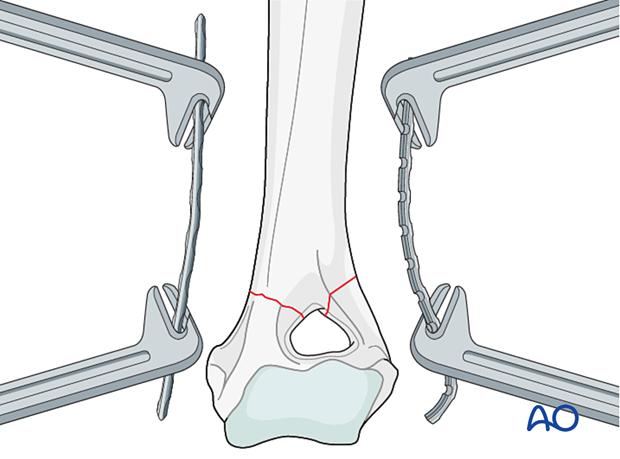
That is why the surgeon often has to manually adapt the shape of the plate before placement. The goal is for all contact points of the plate to be in intimate contact with the bone.
This operation is called contouring or bending the plate.
If the plate is not perfectly adapted, some zones will remain “in the air.” Tightening the screws will not create uniform friction, which leads to:
- a risk of micromovement,
- a loss of stability,
- deformation of the plate during tightening,
- or even loss of reduction of the fracture.
The operation is carried out using contouring pliers or bending pliers, sometimes with a bone template.
Illustration :
✅ Advantages
- Simplicity of use and design.
- Reduced cost (standard plate manufacturing).
- Compatible with standard cortical screws.
- Versatile: can be used on many bone segments.
- Ideal for stable fractures or if there is already good contact between the two bone parts.
⚠️ Disadvantages
- No active compression at the fracture site.
- Requires precise contouring to ensure uniform contact.
- If the plate is poorly adapted → loss of friction, micromovements.
- May compress the periosteum, locally reducing vascularization.
- Less effective on unstable or comminuted fractures.
💬 Takeaway
In a simple plate, stability comes from friction between plate and bone generated by tightening cortical screws.
The surgeon must adapt the plate to the curvature of the bone using contouring pliers to ensure optimal contact and reliable fixation.
Commenting is not enabled on this course.